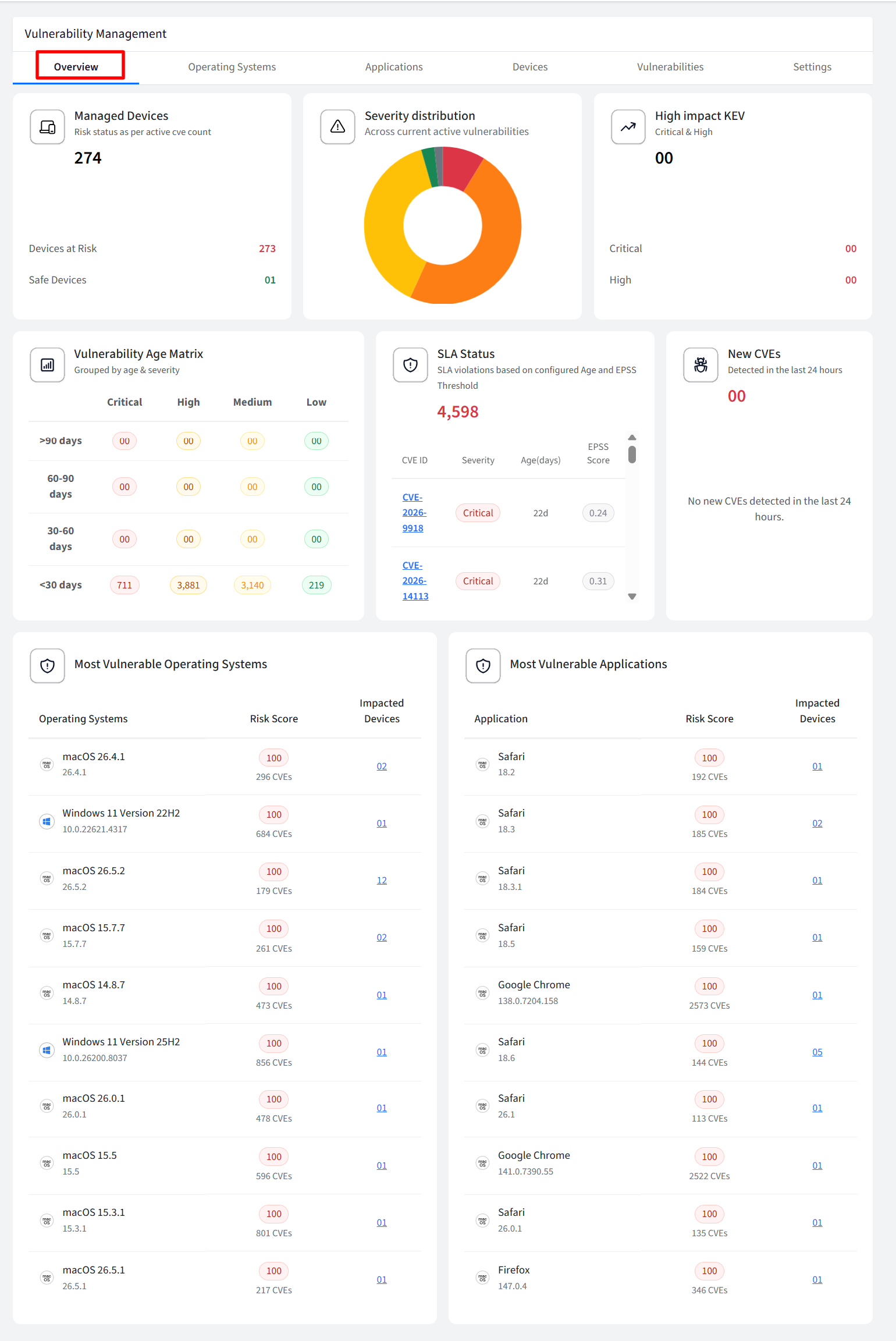
The Overview section in Vulnerability Management provides a consolidated view of your organization’s vulnerability posture. It gives IT administrators a quick way to assess overall risk and identify areas that may require attention. Key highlights:
Overview Cards: Displays summary cards for Managed Devices, Severity Distribution, KEV (Known Exploited Vulnerabilities), Vulnerability Age, SLA Breaches, and New CVEs (detected in the last 24 hours).
Configurable Settings: Allows setting the calculation criteria for Vulnerability Age (by Publish Date or First Detected Date) and customizing thresholds for critical/high SLA days and EPSS percentage.
Top Vulnerability Summaries: Includes widgets listing the top 10 Most Vulnerable Operating Systems and Most Vulnerable Applications, detailing impacted device counts and associated CVEs.
The Overview brings key vulnerability and remediation metrics into a single view, including:
Managed Devices: Provides visibility into the managed devices in your environment and their vulnerability status.
Severity Distribution: Shows the distribution of detected Common Vulnerabilities and Exposures (CVEs) based on their assigned severity levels.
High Impact Known Exploited Vulnerabilities (KEVs): Highlights vulnerabilities that are known to be actively exploited.
Vulnerability Age Matrix: Calculated based on either the published date or the first detection date in the user's environment.
SLA status: Shows vulnerabilities that are approaching or exceeding their remediation timelines. Allows configuration of critical and high-severity thresholds; vulnerabilities exceeding these age limits or Exploit Prediction Scoring System (EPSS) percentages are flagged as SLA breaches.
New CVEs: Summarizes vulnerabilities identified across your environment in the last 24 hours.
Most Vulnerable OS and Applications: Ranks the top 10 operating systems and applications by Risk Score, providing insights into impacted devices and related vulnerabilities.
Use the Overview section to quickly understand your current vulnerability posture, identify areas of elevated risk or urgency, and navigate to the relevant areas for remediation.